A new chapter is opening in the international artificial intelligence research of Pázmány Péter Catholic University. Two major international research networks dedicated to human-centred artificial intelligence are connecting their expertise, institutions and academic communities. The University’s interdisciplinary project, On the Border Between Humans and Machines, and the New Humanism in the Time of Neuroscience and Artificial Intelligence initiative of Lyon Catholic University have agreed to connect their research communities and explore new opportunities for joint academic work.
The cooperation brings together two ambitious international initiatives that approach the transformation caused by artificial intelligence from complementary perspectives. Their shared objective is to ensure that the development and application of AI remain guided by human dignity, freedom, responsibility, justice and the common good.
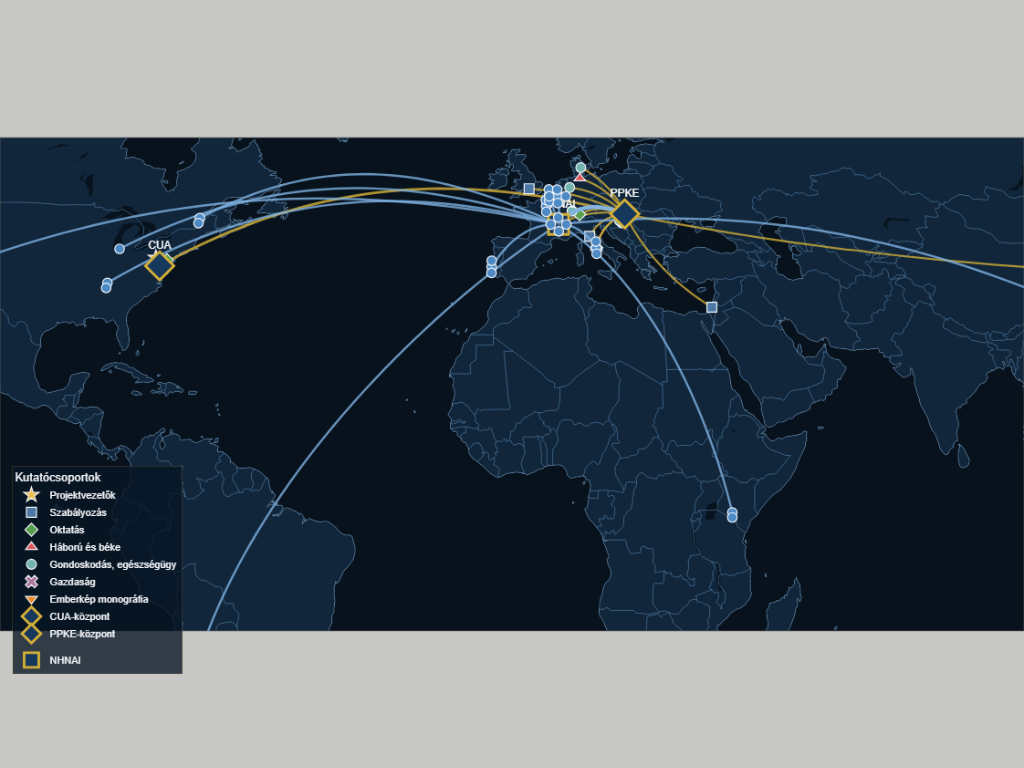
Pázmány Péter Catholic University’s On the Border Between Humans and Machines: Artificial Intelligence, Ethics and New Regulatory Standards project currently connects 54 institutions in 11 countries. Its six research groups examine care and healthcare, war and peace, AI regulation, the economy, education and the changing understanding of the human person. The project combines expertise from the humanities, social sciences, law, theology, healthcare, economics and information technology, including research on AI safety and interpretability.
The New Humanism in the Time of Neuroscience and Artificial Intelligence project, or NHNAI, is coordinated by the Confluence: Sciences and Humanities Research Center at Lyon Catholic University under the aegis of the International Federation of Catholic Universities. Its network includes Catholic universities and research centres in Europe, North America, Latin America, Africa and Asia. NHNAI has developed an innovative methodology that places interdisciplinary academic knowledge at the service of broad societal reflection on what it means to be human in the age of artificial intelligence.
The partnership therefore connects Pázmány’s rapidly expanding international research network with an established global community of Catholic universities and societal partners. It creates a broad international platform for examining one of the defining questions of the twenty-first century: how can humanity use artificial intelligence without weakening the capacities, relationships and responsibilities that make human life genuinely human?
The two projects share the conviction that AI ethics cannot be reduced to technical compliance or the regulation of individual applications. Meaningful governance must also address the goals embedded in the design of AI systems, the social and economic structures that shape their development, and the understanding of the human person upon which the concepts of human-centred AI and human flourishing depend. NHNAI’s 2026 white paper calls for ethical capacity-building, democratic participation, AI literacy and a renewed exploration of humanism as foundations for responsible AI governance. These priorities closely correspond to the anthropological, ethical, legal and technological framework of the Pázmány project.
The cooperation offers numerous opportunities for the researchers of both networks. These include international comparative studies, multicentre empirical research, joint publications, conferences, workshops, policy recommendations and educational programmes. The wider network may also support new opportunities for interdisciplinary cooperation among philosophers, theologians, lawyers, healthcare researchers, economists, social scientists and technical experts.
A major joint international conference is already under preparation for 21-23 April 2027 in Budapest at PPKE. Researchers and institutional partners from both networks will examine the ethical, political and practical conditions required for AI to contribute to human flourishing and the common good. The event will be an important forum for interdisciplinary research, institutional dialogue and the development of new international collaborations.
A call for contributions for the conference has already been published: AI for Human Flourishing – On Human Terms: Fostering Collective Discernment to Safeguard Dignity, Responsibility and the Common Good in the Age of AI invites submissions from researchers, practitioners, and stakeholders engaged with the development and use of artificial intelligence. The conference will focus on two main areas: exploring what it means to be human in the age of AI, and examining how these insights can be translated into concrete ethical guidance and responsible practices. Abstracts for presentations and panel proposals may be submitted until 30 November 2026. The conference, jointly organised by Pázmány Péter Catholic University and the Catholic University of Lyon, will take place in Budapest at Pázmány Péter Catholic University on 21–23 April 2027.
By linking these two international networks, Pázmány Péter Catholic University is strengthening its position as a centre of interdisciplinary and globally connected research on artificial intelligence. The partnership also demonstrates the distinctive contribution Catholic universities can make to the international debate: combining scientific excellence with a clear commitment to the dignity of every human person and to a future in which technological development remains under the guidance of human wisdom and responsibility.
Further information is available on the websites of the On the Border Between Humans and Machines project and the NHNAI project.
The PPKE project is implemented with the support of the National Research, Development and Innovation Fund under project number 2025-3.1.1-ED-2026-00048.