How can theology, philosophy, the social sciences, and the natural sciences respond to the most serious ecological crisis of our time? What methodology should researchers apply when conducting research on the protection of creation? Researchers from four continents explored these questions at a two-day international conference organized by the Research Institute for the Integrity of Creation at Pázmány Péter Catholic University, which focused on the protection of the created world and sustainability. Internationally recognized researchers from 11 countries across four continents participated in the conference.
In his welcoming speech, János Székely, president of the Hungarian Catholic Bishops’ Conference, drew attention to the historical process through which the Catholic Church and other Christian denominations have come to recognize that the protection of the created world is an integral part of Christian social teaching and ethics. Citing Pope Francis’s encyclical 'Laudato si’', he emphasized that “protecting the created world is not an optional task for Christians, but a serious moral obligation. We received the Earth as a Garden of Eden, we cannot leave it behind as a desert for the next generation.” In this context, he highlighted the reality of ecological sins and the need for ecological conversion.
In his speech, the bishop also voiced serious economic and moral criticism. Citing data from Oxfam, he pointed out that the world’s eight richest people possess as much wealth as the poorer half of the global population. This massive concentration of capital fundamentally influences wars, global trade, and ecological processes. However, the Church is convinced that the purpose of economic life is not profit in and of itself, but rather the well-being and fulfillment of human beings - every human being and the whole person.
He also pointed out that the right to private property is not absolute: it is superseded by the principle of the universal destination of goods, that is, every person’s right to a livelihood worthy of human dignity. On a planet with finite resources, unlimited quantitative growth is an illusion. Humanity must therefore grow in quality in knowledge, culture, human relationships, inner values, and joy.
János Székely shed light on the order of creation through biblical parallels. According to the observations of the ancient Jewish rabbis, the phrase “and God said” appears ten times in the creation narrative, linking the word, the Logos, the law, and the logic of creation to the words of the Ten Commandments. If humanity acts on Earth not as a gentle shepherd but as a tyrant, the order of the world collapses and falls back into chaos. In contrast, the ark (a symbol of the temple and harmony) offers refuge.
In closing, he outlined the practical steps taken by the Hungarian Catholic Church, including the transformation of Catholic schools—which educate nearly 12 percent of Hungarian students—into institutions dedicated to the protection of creation. He highlighted three main fruits of this effort: experiencing God through nature, recognizing the objective laws of the created world, and appreciating the value of humility and a more modest material lifestyle.
Following this, Prof. Géza Kuminetz, Rector of Pázmány Péter Catholic University, emphasized in his German-language address the importance of an in-depth dialogue between religion and science in the spirit of sustainability, referring to Pope Francis’s speech delivered at Pázmány Péter Catholic University on April 30, 2023.
Professor Lóránd Ujházi, the conference’s initiator and director of the Research Institute for the Integrity of Creation at Pázmány Péter Catholic University, presented the Institute’s work over the past five years. During this period, they published approximately 100 academic studies on the topic of creation care. In addition, they considered the practical application of the theory to be of paramount importance. Therefore, they organized creation care summer camps for children, conducted teacher training programs, and published creation care storybooks in three different languages. Following the lead of Institute Director Joseph Selling, he pointed out the profound methodological crisis in contemporary Catholic moral theology, which stems from the internal conflict between the traditional deductive method, which examines physical acts in strict isolation and the inductive theological approach that prioritizes human intentions and goals. Drawing on the Apostolic Constitution 'Veritatis gaudium', he emphasized the radical paradigm shift and the absolute necessity of transdisciplinarity and interdisciplinarity, since issues of technology, biology, law, and economics cannot be separated from one another. He also presented the Institute’s new research area, the Global Thinking Program, within the framework of which researchers in countries of the Global South are investigating how environmental degradation and water scarcity lead to direct armed conflicts, migration, and social collapse, thereby linking the protection of creation with crisis management and peace-building.
As an introduction to the plenary presentations, Gusztáv Kovács shared three important points with the participants. First, he explained that the conference was a concrete response to Pope Francis’s call, made more than a decade ago, to protect our common home, the creation. Second, he discussed the conference’s unusual online format, highlighting that by holding the event online instead of in person in Budapest, they saved between 25 and 40 metric tons of carbon-dioxide emission, which is equivalent to the annual ecological footprint of 6–8 people, transcending the boundaries of different time zones and geographical distances. Finally, he articulated the conference’s goal, which is to build a vibrant scientific community capable of high-level academic thought and action for the sake of our shared home, regardless of the thousands of kilometers separating its members.
This was followed by the plenary presentations.
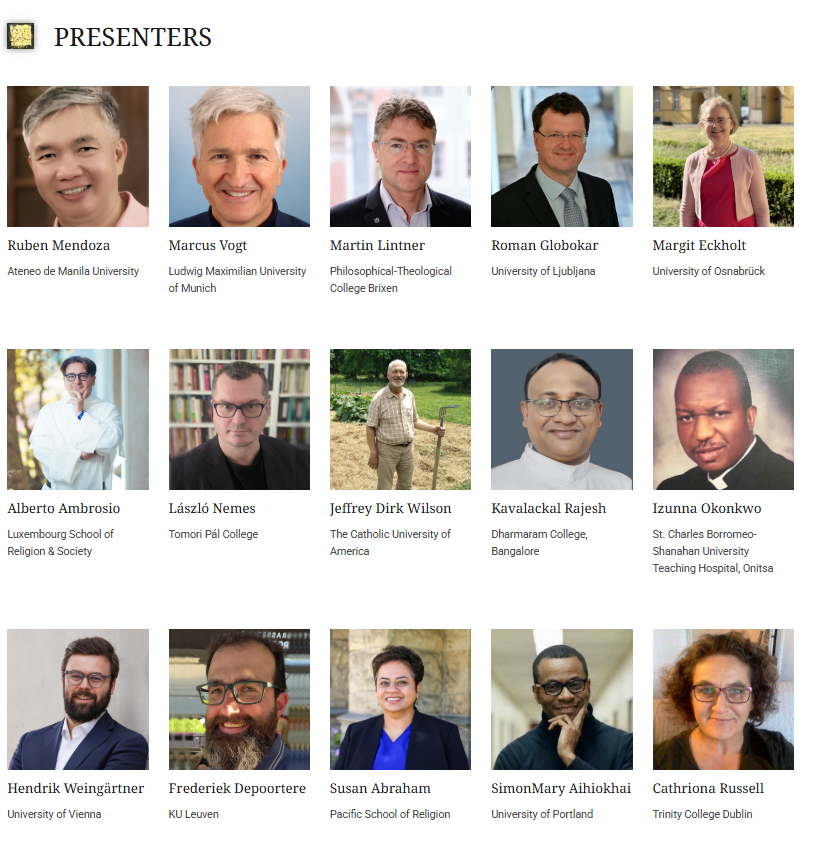
Rajesh Kavalackal (Bangalore) spoke about integrated Christian ecology and Indian religious-philosophical ecotheology, highlighting the connection between doxology and practice. In his presentation, he emphasized that transcending the anthropocentric worldview requires a new spirituality that does not view material reality as evil. He highlighted that the created world is a vessel of God’s presence, therefore, the Christian faith must adopt a panentheistic rather than a pantheistic perspective. Finally, he offered practical recommendations for supporting local environmental movements and changing attitudes toward waste.
Izuna Okonkwo (Onitsa) explored the connections between hunger and the sacred view of nature in traditional African religions, emphasizing respect for the earth. He pointed out that climate change and environmental destruction in Africa directly lead to severe food insecurity and famine. In African cultures, the earth is a sacred entity, therefore, the environmental crisis must be addressed here primarily as a spiritual and religious issue. He emphasized the indispensable role of interfaith dialogue between Christianity, Islam, and traditional African religions in protecting creation.
Hendrik Weingärtner (Vienna) analyzed the relationship between ecological ethics and the relational turn, integrating aspects of the ethics of care into the perspective of new materialism. He examined how new materialist approaches challenge traditional anthropocentric ontology and epistemology. He presented the “ethics of co-being” (Ethik des Miteinanderseins), based on animal ethics and phenomenology, which derives responsibility from encounters with animals. He also explained how care ethics approaches can complement the theories of new materialism without losing sight of the specific responsibility inherent in human action.
Frederiek Depoortere (Leuven) examined the theological tensions between the encyclical 'Laudato si’ and the Gaia hypothesis, raising the challenges posed by the elemental forces of nature. In his analysis, he pointed out that while the papal document portrays the Earth as a gentle “sister” and “mother,” contemporary philosophy - following Bruno Latour and Isabelle Stengers, for example - presents it, through the Gaia hypothesis, as an unpredictable, independent, and powerful force. He emphasized that, in contrast to the Romantic view of nature, we must confront the Earth’s ecosystems’ resistant and even seemingly anti-human reactions. Finally, he raised the question of how the theological concept of creation can integrate the terrifying and majestic dimensions of the planet that are being revealed in the process.
Susan Abraham (San Francisco) attempted to integrate the insights of feminist and postcolonial thinkers into global Catholic ecology, urging a humble dialogue across disciplines. In her presentation, she emphasized the importance of integrated ecology as a space for dialogue in the face of global social and spiritual fragmentation. She highlighted the validity of postcolonial and feminist critiques, which remind us that the distribution of environmental burdens is deeply intertwined with gender and power inequalities. Drawing on the framework of metamodernism, she proposed the method of intellectual “oscillation”, that is, the movement between hope and critique, as a tool for theological renewal.
SimonMary Aihiokhai (Portland), drawing on the reality of Nigeria, outlined a model of interfaith ecology, with particular emphasis on community responsibility. He presented the dramatic social and ecological consequences of oil extraction in Nigeria, such as the environmental destruction occurring in the Niger Delta. He emphasized that, in order to foster ecological solidarity, the church must form alliances with other religious traditions and ancient cultural values. He particularly highlighted the importance of the biblical and Islamic Sabbath, as well as African traditions’ rituals related to rest and the renewal of the earth, as a counterbalance to economic exploitation.
Catriona Russell (Dublin) presented the measurement systems used for sustainability indicators, including the Human Development Index and the Nature Relationship Index, which is currently under development. In her analysis, she compared countries’ levels of economic development with their biocapacity and ecological footprints. She emphasized that new, relationship-based indicators advocated by the United Nations, rather than traditional economic indicators such as GDP, can provide a more nuanced picture of nations’ efforts to protect creation. She explained that statistical data and empirical measurements are essential for transforming theological principles into tangible political and social action.
In his presentation, Ruben Mendoza (Manila) extended the Filipino concept of “malasakit” - which combines deep empathy, solidarity, and care - to the relationship between humans and the natural environment. He pointed out that the bishops of the Philippines had been advocating for ecological conversion in the face of economic exploitation for decades. He analyzed in detail the etymology of the term “malasakit,” which denotes action stemming from the sharing of physical and psychological pain. He explained that by extending this cultural value beyond the family circle to the entire created world, it can serve as an effective moral compass in halting environmental destruction.
Markus Vogt (Munich) presented the wounded creation as the site of divine revelation, taking a critical look at the unbridled optimism placed in technological progress. He highlighted that climate change poses a real existential threat to humanity. He also pointed out that, in a theological sense, today’s ecological crisis is a “sign of the times” through which God speaks to us, and that the harm done to the created world can be likened to the crucifixion of the cosmic Christ. Finally, in contrast to macro-pessimism, he outlined possible paths for social transformation through critical hope, micro-models, and Foucaultian heterotopias.
Martin M. Lintner (Brixen) rethought the dominion mandates of the biblical creation stories within the ethical frameworks of vulnerability and animal protection. In his analysis, he uncovered the ambiguous layers of meaning in these Hebrew verb forms - which encompass both violence and power - that can easily become a justification for violent exploitation. He emphasized, however, that human power cannot entail an unlimited right to destruction but must be exercised as a representation of God’s providential love. Citing Albert Schweitzer’s imperative demanding respect for all life, he highlighted that the shared vulnerability of humans and animals provides the moral foundation for the protection of all living beings.
Roman Globokar (Ljubljana), building on the work of Albert Schweitzer and Hans Jonas, outlined the integrated dimensions of responsibility, a forward-looking perspective and collective action. He explained that the unprecedented growth of modern technological power has created a new gap in responsibility within humanity’s moral development. Drawing on Hans Jonas’s forward-looking ethics of responsibility, he argued that responsibility for the consequences of our actions must extend to future generations as well.
Margit Eckholt (Germany) highlighted the epistemological role of the spirituality of creation within the frameworks of liberation theology and ecofeminism. Drawing on the ideas of Leonardo Boff and Ernesto Cardenal, she demonstrated in her presentation that the spirituality of creation is a fundamental school for perceiving reality. She drew on Sally McFague’s ecofeminist approach to transform our understanding, contrasting the Western “arrogant gaze” with the “loving gaze.” She explained that theological thought must renew its theological reflection on creation, starting from the dynamics of love within the Holy Trinity.
In a provocative and original presentation, Alberto Ambrosio (Luxembourg) linked fashion, clothing, and the concept of “habitus” to the ethics of sustainability and a critique of global consumption. He pointed out that although the encyclical 'Laudato si’ barely mentions one of the world’s most polluting industries, fashion and textile manufacturing have a fundamental impact on ecological balance. Tracing the etymological connections, he demonstrated the deep relationship between clothing (habit), individual behavior (habitus), and our place of residence or environment (habitat). He reminded the audience that responsible clothing habits and the virtue of moderation are key areas of everyday ecological conversion.
László Nemes (Budapest) focused on Christianity as a form of traditional ecological knowledge, highlighting the close intertwining of cultural rituals and ecosystems. Drawing on the philosophy of Pierre Hadot, he presented Christianity not merely as a dogmatic system but as a way of life in its entirety. Through examples, including folk customs, festive rituals, Easter symbols, and traditional farming practices, he demonstrated that European Christian traditions are deeply intertwined with the protection of local ecosystems. He emphasized that solving the modern ecological crisis requires the rediscovery of this forgotten, intergenerational traditional ecological knowledge.
Jeffrey Dirk Wilson (Washington, D.C.) revived the historical concept of “husbandry” - that is, careful stewardship - as a model for local, sustainable agriculture and a distinctive way of life. In his presentation, drawing on medieval and early modern English roots, he introduced the ideal of the careful steward, who does not plunder nature but rather protects, nurtures, and enriches life. He explained that biblical frameworks, the Garden of Eden as the work of the first gardener, and the resurrected Christ as the figure of the gardener, elevate the care of the created world to a sacred art. Finally, he called for practical steps to follow the farming models of local food production, family gardens, and Amish communities.
The two-day conference, organized by the Research Institute for the Integrity of Creation at Pázmány Péter Catholic University, clearly demonstrated that the protection of creation is not merely a narrow academic discipline, but an important aspect of living out the Christian faith, one that demands global solidarity, structural justice, and a profound spiritual conversion from everyone.